

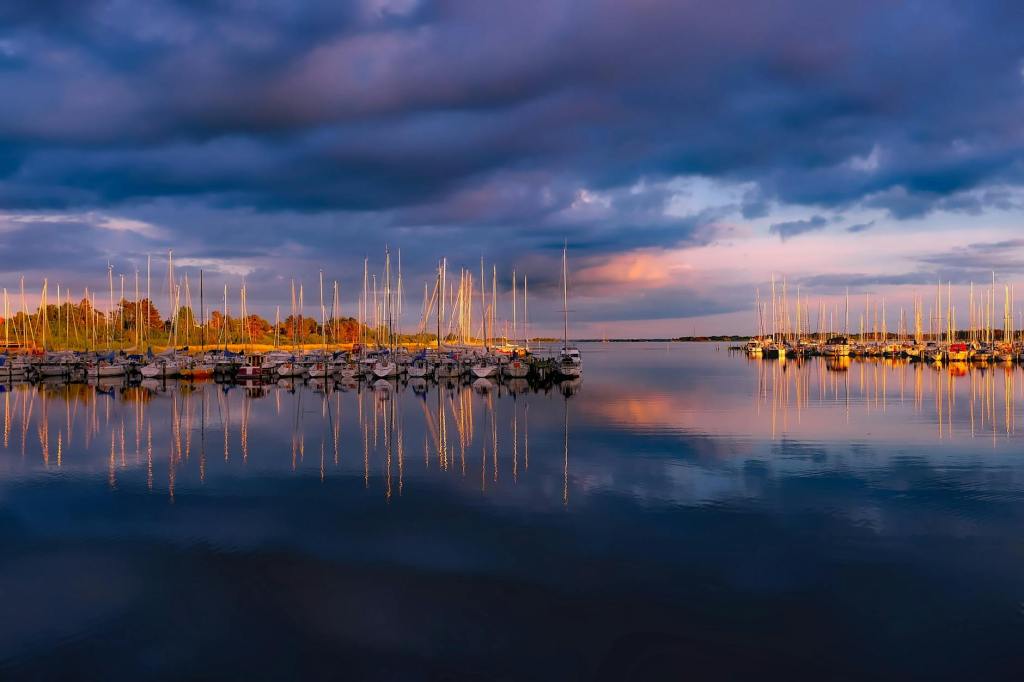
The water was flat. Not calm in the way you’d describe a lake on a warm afternoon, but flat in the way that only happens before the world remembers it’s supposed to move. I was anchored in a small inlet somewhere south of the Chesapeake, coffee going cold in my hand, watching the fog lift off the surface in slow, indifferent rolls. The boats in the slip behind me hadn’t stirred. The dock lines weren’t even taut. The whole scene had the quality of a held breath — the kind where you don’t know if something’s about to happen, or if everything already has.
I’ve had a few mornings like that on the water. You don’t go looking for them. They find you when you’ve finally stopped trying to manage the clock.
Sailing teaches you motion. The harbor teaches you something harder — restraint.
There’s an old idea in seamanship that the most dangerous sailor isn’t the reckless one. It’s the impatient one. The man who leaves on a bad tide because he’s tired of waiting. Who runs through a channel entrance in poor visibility because the schedule says he should be there by noon. The sea doesn’t care about your schedule. It never has. What it rewards is timing — real timing, not the kind that comes from urgency, but the kind that comes from watching long enough to understand what’s actually happening out there.
I didn’t learn this on the water. I learned it at Microsoft, of all places, and the harbor just confirmed it.
· · ·
In the 80s and 90s, speed was the product. Everyone was moving, everything was launching, the whole industry had a fever for it. If you weren’t shipping, you were losing. I believed that for a long time. I was good at it, even. I could execute fast, build fast, scale fast. What I was slower to understand was that speed and progress aren’t the same instrument. They just look alike from a distance.
There were initiatives we pushed through that should have waited — not because they were bad ideas, but because the conditions weren’t right. The market wasn’t ready. The organization wasn’t ready. We had the wind but the tide was still running against us, and we burned a lot of fuel trying to make up for that. The ones that worked — the ones I’m still proud of — those were the ones where someone had the discipline to say: not yet. Two of the hardest words in any room full of ambitious people.
Operational leaders are especially prone to this. We’re wired to solve problems, to remove friction, to move things forward. Stillness feels like failure. But I’ve come to believe that confusing speed with progress is one of the more expensive mistakes you can make, whether you’re running a product team or pointing a boat toward open water.
· · ·
When I left the corporate world in 2000, I thought retirement was about rest. I was wrong about that. Rest, it turns out, is just the first chapter. What comes after — if you’re lucky enough to sit with it long enough — is something closer to clarity.
The harbor is a good teacher for this. Not a gentle one. There’s real discomfort in being anchored when you want to sail. You second-guess yourself. You start reading the weather every twenty minutes hoping for a change you can justify. You invent reasons to go. And then, if you’ve made enough mistakes to know better, you put the binoculars down and you wait.
Stillness is not stagnation. One is chosen. The other happens to you.
That distinction took me years to see clearly. Stagnation is what occurs when you stop engaging with the world. Stillness is what happens when you engage with it deeply enough to know you’re not ready yet — or that the moment isn’t. There’s a version of mid-life that looks like giving up from the outside. From the inside, it looks like finally knowing which fights are worth having and which tides are worth fighting.
· · ·
That morning in the inlet, somewhere around the third cup of coffee, the fog lifted enough to show me the channel markers. The wind had shifted — not dramatically, but enough. I could feel it change the way you feel a room change when someone opens a window. Small, but real. The water had a bit of texture to it now, the kind that says something is happening beyond what you can see.
I pulled the anchor. Not because the clock said it was time, not because I was bored, not because I’d convinced myself the conditions were good enough. I pulled it because they actually were. The difference between those things is everything. You can feel it when you’ve spent enough time learning to wait — the moment the harbor releases you, not the moment you decide you’re done waiting.
That’s the only kind of departure worth making. Not the one the schedule demands. The one the morning earns.
 Joe the Writer
Leave a comment